In software development, randomizing the order of elements in a collection is a common requirement. Whether you are building card games, generating quiz questionnaires with shuffled answers, setting up randomized music playlists, or feeding data into machine learning algorithms for training batches, you need a reliable way to scramble lists.
Java's standard library provides a direct, built-in utility for this inside the Collections framework: Collections.shuffle(List<?> list). This method operates in linear O(N) time complexity and modifies the provided list in-place. By utilizing a proven randomizing algorithm under the hood, Java saves developers from writing custom, bug-prone shuffling routines. In this guide, we will explore how Collections.shuffle() works and walk through a playlist randomizer example.
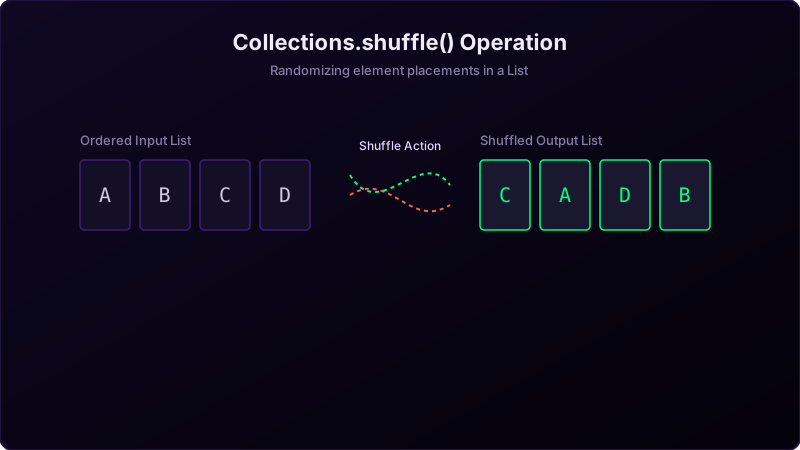
To visualize this utility, imagine you have a fresh deck of playing cards arranged in perfect numerical order: Ace of Spades, 2 of Spades, 3 of Spades, all the way to King of Hearts.
If you want to shuffle them manually, you might make mistakes or leave patterns. Instead, you throw the entire deck into a tumbling raffle drum (representing Collections.shuffle()). You turn the crank, spinning the drum. The machine tumbles and scrambles the cards in completely random directions. When you open the latch and pull the cards out, the deck is thoroughly randomized (yielding an unpredictable order like 3, Ace, 10, 5, 2, Jack). Every card has an equal probability of landing at any position in the deck.
Behind the Scenes: The Fisher-Yates Algorithm
Under the hood, Collections.shuffle() implements a version of the Fisher-Yates shuffle algorithm (also known as the Knuth shuffle). The algorithm works backwards:
- It starts at the last index of the list
i = N - 1. - It generates a random index
jsuch that0 <= j <= i. - It swaps the elements at index
iand indexj. - It decrements
iand repeats the process until it reaches the front of the list.
Java Implementation Code
Below, we load a list of custom Song objects and randomize their playback order using Collections.shuffle:
package io.practise;

import java.util.Arrays;
import java.util.Collections;
import java.util.List;

public class ShufflingSong {
    public static void main(String[] args) {
        Song song1 = new Song("A");
        Song song2 = new Song("B");
        Song song3 = new Song("C");
        Song song4 = new Song("D");
        Song song5 = new Song("E");

        List<Song> playlist = Arrays.asList(song1, song2, song3, song4, song5);

        System.out.println("Original Playlist: " + playlist);

        // Shuffle the list in-place
        Collections.shuffle(playlist);

        System.out.println("Shuffled Playlist: " + playlist);
    }
}

class Song {
    String name;

    public Song(String name) {
        this.name = name;
    }

    public String getName() {
        return name;
    }

    @Override
    public String toString() {
        return "Song{name='" + name + "'}";
    }
}
Conclusion & Best Practices
The Collections.shuffle() method operates in-place, meaning it mutates the original list directly. If you need to preserve the original sorting order of your elements, you must copy the list first (for example, List<Song> shuffledList = new ArrayList<>(originalList);) before invoking the shuffle command. Additionally, if you require reproducible shuffles for unit testing or gaming seeds, you can pass a custom Random instance: Collections.shuffle(list, new Random(seed)).