In object-oriented programming, data integrity is paramount. Java provides the final keyword as the primary tool to enforce immutability, ensuring that once a variable's value is set, it cannot be changed. Typically, final variables are initialized immediately upon declaration (for instance, final int LIMIT = 50;).
However, Java also supports a highly useful feature known as Blank Final Variables. A blank final variable is a final variable that is declared without an immediate initial value. This allows you to defer value assignment to runtime, giving you the flexibility to compute the variable's value dynamically based on constructor arguments, while still obtaining the compiler's strict single-assignment guarantee. In this guide, we will analyze the compilation rules and usage of blank final variables in Java.
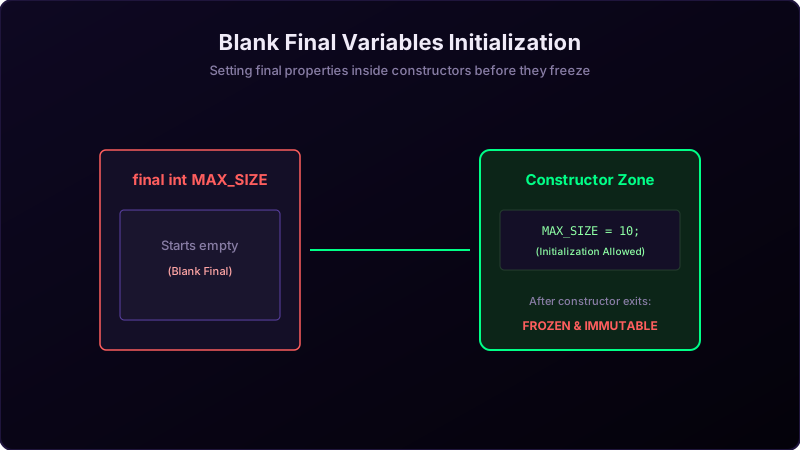
To understand how blank final variables combine flexibility with safety, imagine a custom trophy engraving business:
- The Blank Trophy (The Blank Final Declaration): You maintain a stock shelf of blank silver trophies. These trophies are manufactured with silver cups but have no names, dates, or scores engraved on them. At this point, they are open templates.
- The Engraving Process (The Constructor): When a tournament finishes, you bring a blank trophy into the engraving workshop (representing a class constructor). Here, you engrave the winner's name and the year onto the base.
- The Sealed Award (The Immutable Object): Once the trophy leaves the workshop and is handed to the client, the engraving is permanently set in metal. The name can never be changed, erased, or updated. If you try to write a different name over it later, the trophy is ruined (representing a compiler error).
Strict Initialization & Compilation Rules
The Java compiler performs a sophisticated definite assignment analysis to ensure blank final variables are treated safely. It enforces three strict compilation rules:
- Universal Constructor Assignment: A blank final instance variable must be initialized in every constructor of the class. If a class defines multiple overloaded constructors, each and every constructor execution path must assign a value to the variable.
- Exactly-Once Rule: The compiler guarantees that a blank final variable is assigned a value exactly once. If a constructor attempts to assign a value twice, or if a branch execution could lead to double assignment, compilation fails.
- No Automatic Defaulting: Unlike regular instance fields which get initialized to default values (such as
0,false, ornull), a blank final instance variable is never given a default. It must be explicitly initialized.
Java Implementation Code
Below is the complete Java code showing how a blank final variable is initialized inside overloaded constructors and protected from subsequent modifications:
package io.practise;

class Serialisehasa {
  // Declaring a Blank Final variable
  final int MAX_SIZE;

  // Constructor 1: Default
  Serialisehasa() {
    MAX_SIZE = 10; // Initialize here
    System.out.println("Default MAX_SIZE: " + MAX_SIZE);
  }

  // Constructor 2: Overloaded
  Serialisehasa(int a) {
    MAX_SIZE = a; // Or initialize here
    System.out.println("Custom MAX_SIZE: " + MAX_SIZE);
  }

  public static void main(String[] args) {
    Serialisehasa f = new Serialisehasa();
    Serialisehasa f1 = new Serialisehasa(20);
    f1.finals();
  }

  void finals() {
    // MAX_SIZE = 90; // COMPILER ERROR: Cannot assign a value to final variable 'MAX_SIZE'
    System.out.println("Current value: " + MAX_SIZE);
  }
}
Conclusion & Design Benefits
Blank final variables are essential when designing immutable data models, configuration beans, or thread-safe classes where constants depend on external inputs provided at startup. By deferring initialization to the constructor, you get the best of both worlds: runtime parameterization and compile-time immutability.