In low-level programming languages like C or C++, memory management is the sole responsibility of the developer. You must explicitly request memory blocks on the heap using functions like malloc() or operators like new, and release them using free() or delete. Failing to free memory leads to memory leaks that eventually crash systems, while freeing memory too early creates dangling pointers.
Java eliminates this manual burden by implementing automatic memory management. The Java Virtual Machine (JVM) controls object allocation, traces active references, and runs a background utility called the Garbage Collector (GC) to safely reclaim memory occupied by unreachable objects. In this guide, we will explore the stack and heap divisions and see how the JVM automates cleanup.
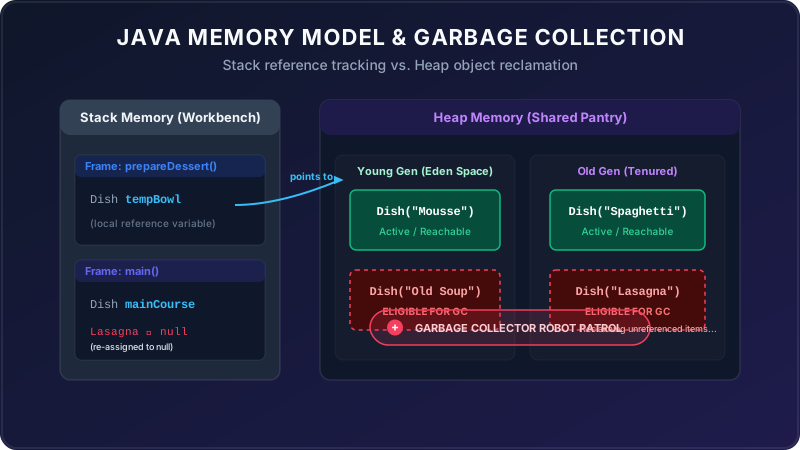
To visualize Java memory management, think of a chef working in a high-volume restaurant kitchen:
- The Prep Counter (
Stack Memory): This is your immediate workbench. It is small, fast, and holds local utensils, spice shakers, and the active recipe cards you are working on (representing local variables and method execution frames). When you finish a recipe step, you clear the workbench completely. - The Shared Pantry (
Heap Memory): This is the large storage area where you place bulk prepared salads, slow-cooked stocks, or dessert bowls (representing instantiated objects). Since they are bulky, you store them in the pantry and place a small sticky note with a locator code on your prep workbench pointing to the pantry shelf (representing object references). - The Cleanup Robot (
Garbage Collector): A cleanup robot periodically patrols the pantry. It checks every bowl. If a bowl has no sticky notes pointing to it from any active workbench recipe cards (meaning it is unreachable), the robot throws it in the trash, freeing up space.
Generational Garbage Collection
Relational mapping shows that most objects die young (such as temporary string builders or loop counters). To avoid scanning the entire heap every time, the JVM divides the heap into age-based generations:
- Young Generation: Composed of Eden and Survivor (S0/S1) spaces. All new objects start in Eden. When Eden fills, a fast Minor GC runs, discarding dead objects and promoting survivors to S0 or S1.
- Old Generation (Tenured): If an object survives several rounds of Minor GC sweeps (for example, application configurations or cache pools), it is promoted to the Old Generation. This area is larger and swept less frequently during a Major GC / Full GC.
Execution Scenarios Trace
Let's trace how these zones interact during standard code execution:
- Instantiation: When you run
Dish mainCourse = new Dish("Lasagna");, the referencemainCoursesits in the stack frame, pointing to aDishobject created in the heap's Eden space. - Re-assignment: Reassigning the reference via
mainCourse = new Dish("Spaghetti");creates a new object and redirects the stack pointer. The original "Lasagna" object is orphaned (unreachable) and marked for GC. - Scope Exit: Calling a helper method creates a nested stack frame. When the method returns, its frame is popped, destroying local reference variables. Any heap objects created inside it that weren't returned now have zero references and are swept away.
Java Implementation Code
Below is the Java implementation tracing object creation, re-assignment, scope exit, and explicit dereferencing:
package io.practise.myPractice;

public class MemoryManagementDemo {
    public static void main(String[] args) {
        // 1. Stack reference 'mainCourse' points to heap Lasagna object
        Dish mainCourse = new Dish("Lasagna");

        // 2. Call prepareDessert() -> pushes a new stack frame
        prepareDessert();
        // Once prepareDessert() returns, its frame is popped.
        // The Mousse object created inside it is now eligible for GC!

        // 3. Re-assigning reference orphans the original Lasagna object
        mainCourse = new Dish("Spaghetti");
        // Spaghetti is now also eligible for GC!

        // 4. Setting to null breaks the final reference path
        mainCourse = null;
        // Spaghetti is now also eligible for GC!

        System.out.println("Memory setup completed. Ready for cleanup robot!");
    }

    private static void prepareDessert() {
        // Stack reference 'tempBowl' exists only inside this method frame
        Dish tempBowl = new Dish("Chocolate Mousse");
        System.out.println("Mixing: " + tempBowl.getName());
    }
}

class Dish {
    private String name;

    public Dish(String name) {
        this.name = name;
    }

    public String getName() {
        return name;
    }
}
Conclusion & Summary
Java's split memory model makes execution fast and safe. The Stack is used for quick, structured method executions, while the Heap holds larger dynamic objects. Thanks to the Garbage Collector, developers don't have to write cleanup code—the JVM automatically monitors references and sweeps away garbage, preventing memory leaks and keeping programs running smoothly!