What We're Solving & Complexity Bounds
Arranging a collection of numeric digits to construct the smallest representation is a common algorithmic puzzle. If you are given a long string of numeric digits, such as "50122", and asked to rearrange the digits to construct the smallest possible number, the standard approach is to perform comparison-based character sorting. However, standard sorting algorithms like Merge Sort or Quick Sort require O(n log n) time.
Since the range of digits is extremely small and fixed (only ten possible digits: 0 through 9), we can optimize this sorting task to a linear O(n) runtime using Counting Sort (also known as bucket sort logic). By allocating a small bucket array to count frequencies, we eliminate character comparisons entirely.
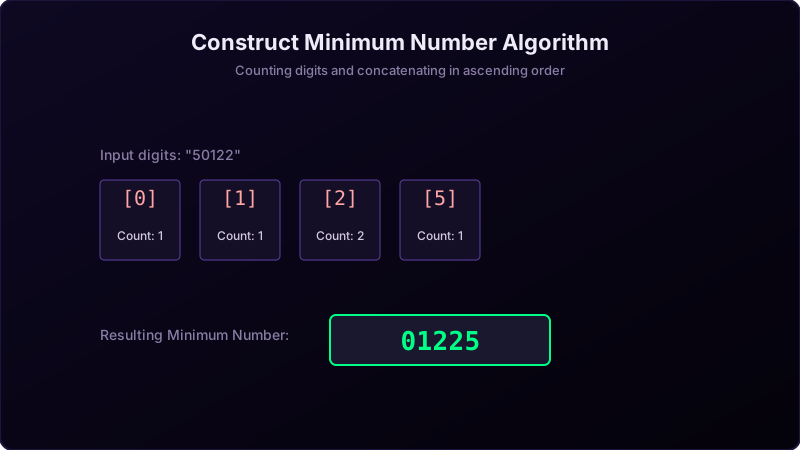
To visualize this approach, imagine organizing a messy pile of numbered toy tiles (each showing a single digit from 0 to 9):
- Tray Sorting: Instead of comparing tiles pair-by-pair, you place 10 plastic trays labeled
0to9on a table. - Counting: You pick up each tile from the pile one by one and drop it into its matching labeled tray. All
0tiles go to tray0, all1tiles go to tray1, and so on. - Reconstruction: To write down the smallest number, you simply look at the trays from left to right, starting at tray
0and finishing at tray9. You pick up all the tiles from each tray in order and lay them out side-by-side.
"01225".
The Strategy
Algorithmic Mechanics (Bucket Allocation)
Let's look at the implementation details of this linear-time sorting method:
- Frequency Array: We allocate an integer array
arrof size10(indices0to9) to store digit counts. - Single-Pass Accumulation: We convert the input string to a character array and loop through it once. For each character, we determine its numeric value and increment the corresponding index in our frequency array:
arr[digit]++. - String Assembly: We initialize a
StringBuilder. We loop through our frequency array from index0to9. If the count at the current indexiis non-zero, we append the digitito our string builder exactly as many times as its count specifies. - Printing the Result: The final constructed string represents the minimum possible number.
Detailed Trace Walkthrough
Let's trace this counting sort execution step-by-step using the input string "5012267075766":
- Step 1 (Initialize Buckets):
- Create frequency array
arrof size 10, initialized to all zeros.
- Create frequency array
- Step 2 (Frequencies Scan):
- Traverse the input characters:
5,0,1,2,2,6,7,0,7,5,7,6,6. - Update frequency indices:
arr[0] = 2(digits:0,0)arr[1] = 1(digits:1)arr[2] = 2(digits:2,2)arr[5] = 2(digits:5,5)arr[6] = 3(digits:6,6,6)arr[7] = 3(digits:7,7,7)
- Traverse the input characters:
- Step 3 (Reconstruction):
- We scan from index
0to9:- Index
0count is2→ Append"00". - Index
1count is1→ Append"1". - Index
2count is2→ Append"22". - Index
5count is2→ Append"55". - Index
6count is3→ Append"666". - Index
7count is3→ Append"777".
- Index
- We scan from index
- Step 4 (Completion):
- The resulting string builder content is
"0012255666777", which is printed to the console.
- The resulting string builder content is
Code Highlights & Explanations
Key aspects of our Java implementation:
Integer.parseInt(String.valueOf(ch))parses each character digit into its corresponding bucket index.- The nested loops reconstruction prints digits in sorted order without utilizing any comparator logic.
The Java Code
package io.practise.string;

public class PrintMinimumPossibleNumber {
    public static void main(String[] args) {
        String num = "5012267075766";

        // 10 digits (0 to 9)
        int[] arr = new int[10];
        char[] chars = num.toCharArray();

        // Count frequencies of each digit
        for (char ch : chars) {
            arr[Integer.parseInt(String.valueOf(ch))]++;
        }

        StringBuilder stringBuilder = new StringBuilder();

        // Append digits in ascending order to construct the minimum number
        for (int i = 0; i < arr.length; ++i) {
            if (arr[i] != 0) {
                for (int j = 1; j <= arr[i]; ++j) {
                    stringBuilder.append(i);
                }
            }
        }

        System.out.println("Minimum possible number: " + stringBuilder);
    }
}
Conclusion & Takeaways
By replacing comparison-based sorting with element frequency counting, we achieve O(N) linear runtime. This makes sorting millions of digits run instantaneously. This optimization is a powerful reminder that bounded data ranges allow us to bypass general-case complexity bounds entirely.