Modern processor architectures rely heavily on concurrent execution to maximize efficiency. In Java, the fundamental unit of concurrent execution is the Thread. To delegate a task to run asynchronously alongside the main program flow, you must define a custom execution payload. Java provides two classic built-in mechanisms to achieve this: extending the Thread class or implementing the Runnable interface.
While both achieve concurrent execution, they represent completely different object-oriented designs. Choosing the wrong mechanism can restrict your class inheritance options and complicate thread pool integration. In this guide, we will analyze both mechanisms, compare their features, and trace a full code implementation.
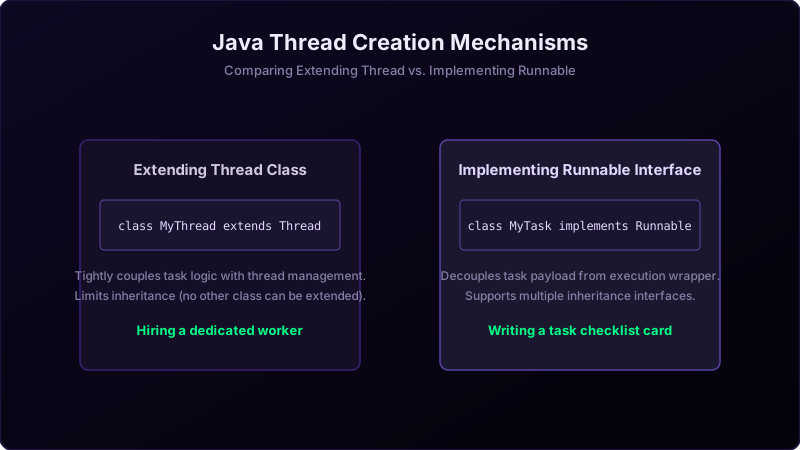
To visualize the difference between these two approaches, imagine managing a busy city pizza shop:
- Extending Thread (The Dedicated Pizza Delivery Driver): You hire a worker whose entire identity is defined as a Pizza Delivery Driver (
MyThread). They come with a built-in delivery cycle. This setup is simple to deploy immediately, but it is highly rigid: because Java class inheritance is single-parent, this employee cannot help with kitchen cleanup or phone orders because their class lineage is locked as a driver. - Implementing Runnable (The Recipe Checklist Card): Instead of hiring a specialized driver, you write down delivery steps on a recipe index card (
MyRunnable). You can hand this index card to *any* employee you currently have, or toss it into a kitchen task queue (representing a Thread Pool).
Runnable keeps your tasks decoupled from the physical threads executing them, giving you massive design flexibility.
Extending Thread vs. Implementing Runnable
| Feature Description | Extending the Thread Class | Implementing the Runnable Interface |
|---|---|---|
| Class Inheritance Limit | Restricted: Java allows extending only one class. Extending Thread blocks further inheritance. | Unrestricted: Your class can inherit from any domain parent class while implementing the interface. |
| Architecture Decoupling | Tightly Coupled: The task logic is merged directly with the operating system thread execution class. | Loosely Coupled: Task payload is fully isolated, making it easy to submit tasks to thread pools. |
| Resource Sharing | Isolated: Each thread instance holds its own unique state fields. | Shared: A single Runnable instance can be shared concurrently across multiple active threads. |
Full Code Implementation
Here is a complete Java program demonstrating how to define, initialize, and execute threads using both class extension and interface implementation:
package io.practise.threadsExample;

public class ThreadExample {
    public ThreadExample() {
        // Approach 1: Extending Thread
        new SimpleThread("Thread 1").start();
        new SimpleThread("Thread 2").start();

        // Approach 2: Implementing Runnable
        Thread thread = new Thread(new SecondSimpleThread());
        thread.start();
    }

    public static void main(String args[]) {
        new ThreadExample();
    }
}

// Approach 1: Extend Thread class
class SimpleThread extends Thread {
    public SimpleThread(String name) {
        super(name);
    }

    @Override
    public void run() {
        for (int i = 0; i < 5; i++) {
            System.out.println(this.getName() + " " + i);
        }
    }
}

// Approach 2: Implement Runnable interface
class SecondSimpleThread implements Runnable {
    @Override
    public void run() {
        for (int i = 0; i < 5; i++) {
            System.out.println(this.getClass().getSimpleName() + " " + i);
        }
    }
}
Conclusion & Production Guidelines
In production-grade enterprise code, implementing Runnable (or the newer Callable interface which supports returning values and throwing checked exceptions) is the recommended standard. Implementing Runnable is also the foundation for Java's functional programming. Since Runnable is a functional interface (having a single abstract run() method), it can be expressed directly as a lambda expression: new Thread(() -> System.out.println("Running")).start();. This allows for extremely compact asynchronous task submission without creating boilerplate subclass definitions.
By keeping your execution payloads decoupled from thread management, you can seamlessly transition tasks to concurrency frameworks like ExecutorService, customize thread pools, and write clean, scalable asynchronous code.