In Java, enums are far more than a simple sequence of named string constants like they are in C or C++. Java enums represent full-fledged classes under the hood. They can contain fields, constructors, instance variables, and custom methods.
One of the most advanced and powerful OOP features supported by Java's enum model is the ability to write constant-specific class bodies. This feature allows individual enum constants to declare their own class bodies, enabling specific enum items to override instance methods or implement abstract methods uniquely. By assigning custom behaviors directly to constants, we can implement clean, polymorphic designs without writing sprawling conditional statements.
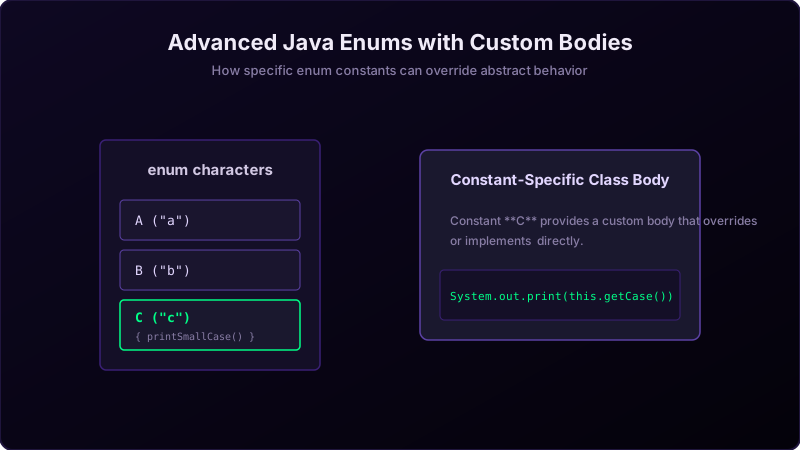
To understand constant-specific class bodies, picture a smart home switch panel on a wall containing three buttons: ON, OFF, and PARTY.
Each button is a switch option, but pressing them triggers distinct actions:
- Pressing ON triggers standard behavior: turns the lights to full brightness.
- Pressing OFF triggers standard behavior: shuts the lights off completely.
- Pressing PARTY, however, triggers something custom: it overrides the standard switch behavior to cycle colors dynamically, dim the main lights, and start playing dance music!
Technical Strategy & Code Design
We can implement this design pattern in Java:
- We declare our enum with constants.
- If we define an abstract method at the enum class level, every constant must provide a constant-specific class body that implements that method.
- Alternatively, we can define a default package-private or public method at the enum level. Constants can choose to inherit this default behavior, or they can optionally open a pair of curly braces
{}after their declaration to define a custom class body and override the method.
Step-by-Step Scenario Walkthrough
Let's trace how the JVM processes our characters enum:
- When the JVM initializes the enum, it instantiates three constants:
A,B, andC. - Constants
AandBcarry the constructor parameter but do not declare custom bodies. When they invokeprintSmallCase(), they execute the default implementation defined at the class level. - Constant
Cis compiled as an anonymous subclass ofcharacters. It overridesprintSmallCase(). WhenC.printSmallCase()is invoked, it successfully executes the overridden code, printing its small-case representation"c"to the console.
Java Implementation Code
Below is the complete Java code showing how to define constant-specific class bodies and use them inside a standard execution framework.
package io.practise.ocpPractise;

public enum characters {
  A("a"),
  B("b"),

  // Constant C provides a constant-specific class body that overrides printSmallCase
  C("c") {
    @Override
    public void printSmallCase() {
      System.out.print(this.getCase());
    }
  };

  private String smallCase;

  // Private constructor for enum constants
  private characters(String se) {
    this.smallCase = se;
  }

  public String getCase() {
    return this.smallCase;
  }

  // Base package-private method
  void printSmallCase() {
    throw new UnsupportedOperationException("Not supported yet.");
  }
}
Conclusion & Design Benefits
Constant-specific method bodies enable you to implement the Strategy Design Pattern directly within a clean Enum structure, eliminating messy switch-case logic blocks across your codebase and improving type safety, readability, and code maintainability.