Problem Breakdown
The Symmetric Tree problem asks us to check whether a binary tree is a mirror of itself (i.e., symmetric around its center).
For example, the tree:
              1
             / \
            2   2
           / \ / \
          3  4 4  3
is symmetric. However, the tree:
              1
             / \
            2   2
             \   \
             3    3
is not symmetric. This problem checks understanding of structural symmetry and simultaneous traversal of
multiple subtrees.
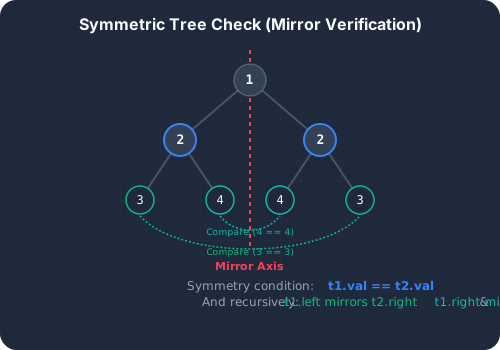
Imagine looking at a butterfly's wings. For the butterfly to be symmetric, every pattern on the outer edge of the left wing must match the pattern on the outer edge of the right wing, and every pattern on the inner edge of the left wing must match the pattern on the inner edge of the right wing. In terms of a binary tree, this means the left child of the left node must match the right child of the right node, and the right child of the left node must match the left child of the right node. By checking these corresponding mirror paths, we can determine symmetry!
Core Algorithm
1. Recursive Mirror Check (O(n) Time, O(h) Space)
We write a helper function isMirror(TreeNode t1, TreeNode t2) that compares two subtrees.
- If both nodes are
null, they are symmetric mirrors. We returntrue. - If only one of them is
null(or if their values are different), they are not symmetric. We returnfalse. - Otherwise, we recursively check:
- If the outer children are mirrors:
isMirror(t1.left, t2.right). - If the inner children are mirrors:
isMirror(t1.right, t2.left).
- If the outer children are mirrors:
O(n) time complexity. The space complexity is
O(h) due to the call stack size.
How It Works
Let's trace the recursive mirror check on the tree [1, 2, 2, 3, 4, 4, 3]:
- Step 1 (Root call):
- If the root is null, we return true. It is not.
- We call the helper:
isMirror(root.left, root.right), which isisMirror(node2_left, node2_right).
- Step 2 (Compare Left & Right subtrees):
- Both nodes have value
2. We proceed. - We must check the outer children:
isMirror(node2_left.left, node2_right.right)which compares node3 (left)and node3 (right). - We must check the inner children:
isMirror(node2_left.right, node2_right.left)which compares node4 (left)and node4 (right).
- Both nodes have value
- Step 3 (Check Outer matches): We evaluate
isMirror(node3_left, node3_right):- Both are leaf nodes with value
3. Their recursive sub-calls returntrue. - So outer check returns
true.
- Both are leaf nodes with value
- Step 4 (Check Inner matches): We evaluate
isMirror(node4_left, node4_right):- Both are leaf nodes with value
4. Their sub-calls returntrue. - So inner check returns
true.
- Both are leaf nodes with value
- Step 5 (Completion): Since both checks return
true, the tree is successfully verified as symmetric around its center. We returntrue.
Code Breakdown
Here is why the main logic in the solution is important:
if (t1 == null && t2 == null) return true;: The base case representing two matched empty subtrees.if (t1 == null || t2 == null) return false;: Catches structural mismatches where one side has a node and the other does not.isMirror(t1.left, t2.right) && isMirror(t1.right, t2.left): The core mirror comparison logic, matching outer elements and inner elements of the subtrees recursively.
Implementation in Java
Below is the complete, self-contained Java source code that solves this problem. It also includes a
main method that traces the execution with console outputs.
package io.practise.dsa;

public class SymmetricTree {

    public static class TreeNode {
        public int val;
        public TreeNode left, right;
        public TreeNode(int val) { this.val = val; }
    }

    // Recursive Mirror Check - O(n)
    public boolean isSymmetric(TreeNode root) {
        if (root == null) return true;
        return isMirror(root.left, root.right);
    }

    private boolean isMirror(TreeNode t1, TreeNode t2) {
        if (t1 == null && t2 == null) return true;
        if (t1 == null || t2 == null) return false;
        return (t1.val == t2.val) && isMirror(t1.left, t2.right) && isMirror(t1.right, t2.left);
    }

    public static void main(String[] args) {
        SymmetricTree solver = new SymmetricTree();
        TreeNode root = new TreeNode(1);
        root.left = new TreeNode(2);
        root.right = new TreeNode(2);
        root.left.left = new TreeNode(3);
        root.right.right = new TreeNode(3);

        System.out.println("--- Symmetric Tree Demonstration ---");
        System.out.println("Is Symmetric: " + solver.isSymmetric(root));
    }
}
Wrapping Up
Solving the Symmetric Tree problem highlights how we can leverage key data structures and algorithmic paradigms (like two pointers, hash maps, or dynamic programming) to significantly optimize runtime and simplify code complexity.