Problem Breakdown
The Rotate Array problem asks us to shift the elements of an array to the right by
k steps, where k is a non-negative integer.
For example, if we have the array [1, 2, 3, 4, 5, 6, 7] and we want to rotate it by
k = 3, the output should be [5, 6, 7, 1, 2, 3, 4]. The primary challenge is
performing this rotation efficiently in-place with O(1) auxiliary space, as creating copies of
large arrays is not memory-efficient.
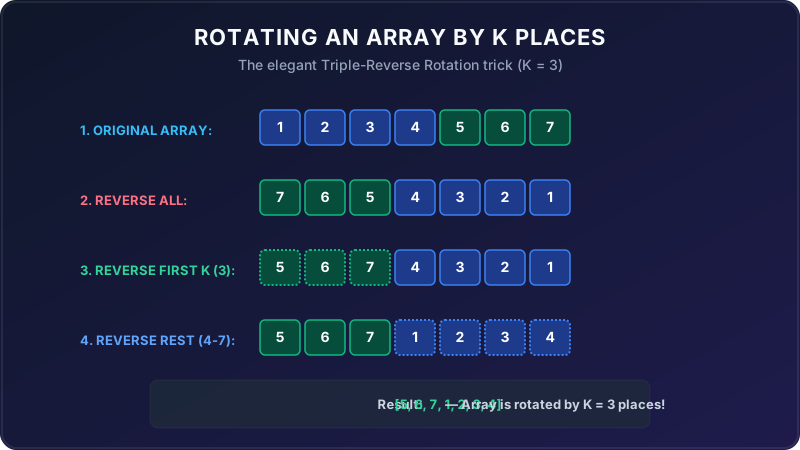
Imagine you have a stack of cards numbered from 1 to 7. You want to move the
bottom 3 cards (5, 6, 7) to the top, so they appear first, while keeping the rest
in order. A simple, elegant way to do this without using any helper trays is to reverse the entire stack
first. This places the bottom elements at the top, but they are backwards: 7, 6, 5, 4, 3, 2, 1.
Now, reverse just the first 3 cards: they become 5, 6, 7. Finally, reverse the
remaining 4 cards: they become 1, 2, 3, 4. Combined, the stack is now
5, 6, 7, 1, 2, 3, 4. The rotation is complete and we didn't need any extra space!
The Strategy
1. The Naive Approach (O(n * k) Time, O(1) Space)
We can shift the elements of the array to the right by one position, k times. While this is
in-place, the time complexity is O(n * k). If k is large, this is extremely slow.
2. Extra Array Approach (O(n) Time, O(n) Space)
We can copy the elements to a temporary array at their new calculated positions:
newPosition = (currentPosition + k) % size. After that, we copy it back. This takes linear time
but uses O(n) extra memory.
3. The Reversal Algorithm (O(n) Time, O(1) Space)
This is the most optimized approach. By reversing segments of the array, we can achieve rotation in-place in linear time. The steps are:
- Perform modulo operation on
k:k = k % sizeto handle cases wherekis larger than the array length. - Reverse the entire array.
- Reverse the first
kelements. - Reverse the remaining
n - kelements.
O(n) time complexity and O(1) space complexity.
Step-by-Step Execution
Let's trace the reversal rotation on the array nums = [1, 2, 3, 4, 5, 6, 7] with
k = 3:
- Step 1 (Normalize k):
k = 3 % 7 = 3. - Step 2 (Reverse the entire array):
- We call
reverse(nums, 0, 6). - Pointers at index
0and6swap values. Pointers move inwards and repeat. - Array changes:
[1, 2, 3, 4, 5, 6, 7]→[7, 6, 5, 4, 3, 2, 1].
- We call
- Step 3 (Reverse the first k elements):
- We call
reverse(nums, 0, k - 1)which isreverse(nums, 0, 2). - This reverses the subarray
[7, 6, 5]. - Array changes:
[7, 6, 5, 4, 3, 2, 1]→[5, 6, 7, 4, 3, 2, 1].
- We call
- Step 4 (Reverse the remaining elements):
- We call
reverse(nums, k, nums.length - 1)which isreverse(nums, 3, 6). - This reverses the subarray
[4, 3, 2, 1]. - Array changes:
[5, 6, 7, 4, 3, 2, 1]→[5, 6, 7, 1, 2, 3, 4].
- We call
- Step 5 (Completion): The rotation is complete. The resulting array is
[5, 6, 7, 1, 2, 3, 4].
Code Breakdown
Here is why the main logic in the solution is important:
k %= nums.length;: Ensures we do not perform redundant full-circle rotations. For example, rotating an array of size 5 by 6 steps is equivalent to rotating it by 1 step.reverse(nums, 0, nums.length - 1);: Places all elements that need to end up at the front in the correct left half, although their internal order is inverted.reverse(nums, 0, k - 1);andreverse(nums, k, nums.length - 1);: Restore the original relative ordering of the two segments after the global reversal.
Java Solution
Below is the complete, self-contained Java source code that solves this problem. It also includes a
main method that traces the execution with console outputs.
package io.practise.dsa;

import java.util.Arrays;

public class RotateArray {

    // Brute Force - O(n * k)
    public void rotateBrute(int[] nums, int k) {
        k %= nums.length;
        for (int i = 0; i < k; i++) {
            int last = nums[nums.length - 1];
            for (int j = nums.length - 1; j > 0; j--) {
                nums[j] = nums[j - 1];
            }
            nums[0] = last;
        }
    }

    // Optimized - O(n) with reversal
    public void rotate(int[] nums, int k) {
        k %= nums.length;
        reverse(nums, 0, nums.length - 1);
        reverse(nums, 0, k - 1);
        reverse(nums, k, nums.length - 1);
    }

    private void reverse(int[] nums, int start, int end) {
        while (start < end) {
            int temp = nums[start];
            nums[start++] = nums[end];
            nums[end--] = temp;
        }
    }

    public static void main(String[] args) {
        RotateArray solver = new RotateArray();
        int[] nums = {1, 2, 3, 4, 5, 6, 7};
        int k = 3;

        System.out.println("--- Rotate Array Demonstration ---");
        System.out.println("Input Array: " + Arrays.toString(nums));
        System.out.println("Rotate Right by: " + k);

        int[] testNums = nums.clone();
        System.out.println("\nExecuting Reversal-Based Rotation...");
        System.out.println("Step 1: Reverse entire array -> " + Arrays.toString(testNums));
        solver.reverse(testNums, 0, testNums.length - 1);
        System.out.println("  Result: " + Arrays.toString(testNums));

        System.out.println("Step 2: Reverse first k elements (0 to k-1) -> " + Arrays.toString(testNums));
        solver.reverse(testNums, 0, k - 1);
        System.out.println("  Result: " + Arrays.toString(testNums));

        System.out.println("Step 3: Reverse remaining elements (k to end) -> " + Arrays.toString(testNums));
        solver.reverse(testNums, k, testNums.length - 1);
        System.out.println("  Result: " + Arrays.toString(testNums));
    }
}
Takeaways
Solving the Rotate Array problem highlights how we can leverage key data structures and algorithmic paradigms (like two pointers, hash maps, or dynamic programming) to significantly optimize runtime and simplify code complexity.