The Challenge
The Reverse a Linked List problem is a core data structures challenge. We are given the head of a singly linked list, and we need to reverse the list so that the nodes point in the opposite direction, returning the new head of the reversed list.
For example, if the input is 1 -> 2 -> 3 -> 4 -> null, the reversed list should be
4 -> 3 -> 2 -> 1 -> null. The constraint is that we should perform this operation in-place using
constant auxiliary space O(1), which means we must carefully manipulate the existing references.
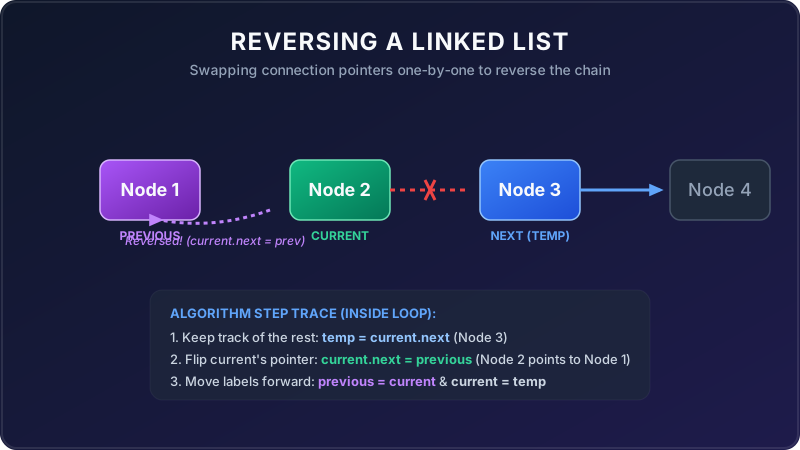
Imagine a conga line where each person has their hands on the shoulders of the person in front of them,
pointing to the direction of travel. To reverse the direction of the line without making anyone move to a
different position, each person must turn around and place their hands on the shoulders of the person who
was previously *behind* them. In code, the "shoulders" are the next pointer references of the
list nodes. Each node must swap its forward link to point to its predecessor.
The Strategy
1. Iterative Pointer Reordering (O(n) Time, O(1) Space)
We traverse the list once. For each node, we redirect its next pointer to the previous node
(prev). To avoid losing track of the rest of the list when we break the link, we must save the
next node in a temporary variable (nextNode) before rewriting the pointer. We use three pointers:
prev: Keeps track of the node that will become the new next node (starts asnull).curr: The current node we are processing (starts ashead).nextNode: A temporary placeholder to storecurr.next.
O(n) time using only constant O(1) memory.
The Inner Workings
Let's trace the iterative reversal on the list 1 -> 2 -> 3 -> null:
- Step 1 (Initialization):
prev = nullcurr = 1
- Step 2 (First Iteration, Node 1):
- Save the next node:
nextNode = curr.next(which is node2). - Reverse the link:
curr.next = prev(which isnull). Now, node 1 points to null:1 -> null. - Move pointers forward:
prev = curr (1),curr = nextNode (2).
- Save the next node:
- Step 3 (Second Iteration, Node 2):
- Save the next node:
nextNode = curr.next(which is node3). - Reverse the link:
curr.next = prev(which is node1). Now, node 2 points to node 1:2 -> 1 -> null. - Move pointers forward:
prev = curr (2),curr = nextNode (3).
- Save the next node:
- Step 4 (Third Iteration, Node 3):
- Save the next node:
nextNode = curr.next(which isnull). - Reverse the link:
curr.next = prev(which is node2). Now, node 3 points to node 2:3 -> 2 -> 1 -> null. - Move pointers forward:
prev = curr (3),curr = nextNode (null).
- Save the next node:
- Step 5 (Completion): Since
curris nownull, the loop ends. We returnprev, which is node3, representing the new head of the reversed list:3 -> 2 -> 1 -> null.
How the Code Works
Here is why the main logic in the solution is important:
ListNode nextNode = curr.next;: Keeps a reference to the remaining chain before we break the forward link.curr.next = prev;: The actual reversal step, redirecting the arrow backward to the node we just visited.prev = curr; curr = nextNode;: Steps the pointers forward by one node to continue the traversal.
The Java Code
Below is the complete, self-contained Java source code that solves this problem. It also includes a
main method that traces the execution with console outputs.
package io.practise.dsa;

public class ReverseLinkedList {

    public static class ListNode {
        public int val;
        public ListNode next;
        public ListNode(int val) { this.val = val; }
    }

    // Optimized - Iterative O(n)
    public ListNode reverseList(ListNode head) {
        ListNode prev = null;
        while (head != null) {
            ListNode nextNode = head.next;
            head.next = prev;
            prev = head;
            head = nextNode;
        }
        return prev;
    }

    public static void main(String[] args) {
        ReverseLinkedList solver = new ReverseLinkedList();
        ListNode head = new ListNode(1);
        head.next = new ListNode(2);
        head.next.next = new ListNode(3);

        System.out.println("--- Reverse Linked List Demonstration ---");
        System.out.print("Original List: ");
        printList(head);

        ListNode reversed = solver.reverseList(head);
        System.out.print("Reversed List: ");
        printList(reversed);
    }

    private static void printList(ListNode head) {
        ListNode curr = head;
        while (curr != null) {
            System.out.print(curr.val + (curr.next != null ? " -> " : ""));
            curr = curr.next;
        }
        System.out.println();
    }
}
Wrapping Up
Solving the Reverse a Linked List problem highlights how we can leverage key data structures and algorithmic paradigms (like two pointers, hash maps, or dynamic programming) to significantly optimize runtime and simplify code complexity.