What We're Solving & Mirror Structures
Finding palindromes within larger string sequences is a classic string analysis challenge frequently featured in technical interviews. The Longest Palindromic Substring problem requires us to locate the longest contiguous block of characters that reads exactly the same both forwards and backwards.
For example, in the string s = "babad", the longest palindromic substring is either "bab" or "aba", both having a length of 3. In s = "cbbd", the longest palindromic substring is "bb" of length 2.
Locating symmetric regions is crucial in several computational domains:
- Bioinformatics: Used to detect inverted repeats in DNA strands, which indicate protein folding sites and transcription regulations.
- Data Compression: Identifying recurring mirror sequences allows optimization of dictionary-based compression codecs.
- Natural Language Processing: Helpful in spell-checking, text segmentation, and semantic structural parsing.
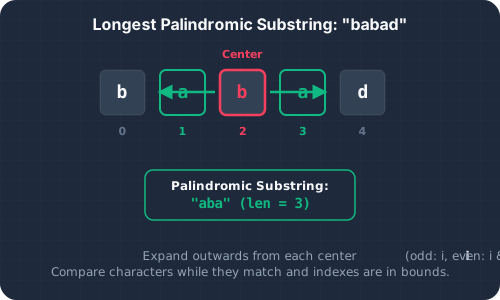
To visualize the expansion strategy, imagine walking down a long pathway lined with letter blocks:
- Outside-In Checking (Brute Force): To check if a segment is symmetric, you walk to the outer ends and step inward one block at a time, checking if the letters match. If you do this for every possible pair of block combinations, you will be exhausted (this scales quadratically).
- Inside-Out Checking (The Expansion Walk): Instead, you stand on a single block (or stand in the gap *between* two blocks) and act as a mirror center. You stretch out both arms simultaneously. As long as the letters under your left and right hands are identical, you take a step outward and stretch again.
Solving the Problem
1. The Brute Force Search (O(n³) Complexity)
A naive solution generates every possible substring within the input string and verifies if it is a palindrome. Generating all substrings takes O(n²) iterations, and verifying each palindrome takes O(n) character comparisons. The cumulative O(n³) runtime makes it completely unusable for large datasets.
2. The Expand Around Center Method (O(n²) Time, O(1) Space)
An elegant optimization is to treat every character and space as a potential palindrome center and expand outwards. A string of length n contains exactly 2n - 1 possible centers: n centers on the characters themselves (odd-length palindromes like "aba") and n - 1 centers in the gaps between characters (even-length palindromes like "abba").
For each center, we expand outward using two pointers until a character mismatch occurs or we hit the boundaries. This reduces the runtime to O(n²) while maintaining O(1) space, which is highly efficient.
Detailed Trace Walkthrough
Let's trace the Expand Around Center algorithm step-by-step on the string s = "babad":
- Step 1 (Initialization): We set pointers to record our maximum palindrome span:
start = 0,end = 0. - Step 2 (Index i = 0, Character 'b'):
- Odd expansion (centered at
0): Matches'b'. Out of bounds immediately. Length =1. - Even expansion (centered between
0and1): Left is'b', right is'a'(mismatch). Length =0. - Max length =
1. Pointers remain:start = 0, end = 0.
- Odd expansion (centered at
- Step 3 (Index i = 1, Character 'a'):
- Odd expansion (centered at
1): Matches'a'. We step outward: left index0 ('b')matches right index2 ('b'). We step outward again: left index-1is out of bounds. Length =3(substring"bab"). - Even expansion (centered between
1and2): Left is'a', right is'b'(mismatch). Length =0. - Max length is
3. Since3 > (end - start + 1), we update pointers:start = 1 - (3 - 1)/2 = 0,end = 1 + 3/2 = 2. Current longest:"bab".
- Odd expansion (centered at
- Step 4 (Index i = 2, Character 'b'):
- Odd expansion (centered at
2): Matches'b'. Step outward: left index1 ('a')matches right index3 ('a'). Substring"aba". Step outward: left index0 ('b')mismatches right index4 ('d'). Length =3. - Even expansion (centered between
2and3): Mismatch between'b'and'a'. Length =0. - Max length is
3. Since3is not strictly larger than our current span of3, the pointers remain:start = 0, end = 2.
- Odd expansion (centered at
- Step 5 (Index i = 3, Character 'a'):
- Odd expansion yields
1. Even expansion yields0.
- Odd expansion yields
- Step 6 (Index i = 4, Character 'd'):
- Odd expansion yields
1. Even expansion yields0.
- Odd expansion yields
- Step 7 (Completion):
- Loop terminates. We extract
s.substring(start, end + 1)which maps tos.substring(0, 3), returning"bab"(or"aba"depending on check order).
- Loop terminates. We extract
How the Code Works
The key highlights of our Java implementation:
expand(s, i, i)checks for odd palindromes centered ati.expand(s, i, i + 1)checks for even palindromes centered in the gap betweeniandi + 1.while (left >= 0 && right < s.length() && s.charAt(left) == s.charAt(right))is the expansion condition, stepping outwards (left--,right++) as long as symmetry holds.return right - left - 1calculates the palindrome length (correcting for the off-by-one mismatch step).
Full Code Solution
Below is the complete Java implementation featuring both the brute-force search and the optimized O(n²) Expand Around Center algorithm, along with a main runner method.
package io.practise.dsa;

public class LongestPalindromicSubstring {

    // Brute Force - O(n^3)
    public String longestPalindromeBrute(String s) {
        int maxLen = 0;
        String result = "";
        for (int i = 0; i < s.length(); i++) {
            for (int j = i; j < s.length(); j++) {
                String sub = s.substring(i, j + 1);
                if (isPalindrome(sub) && sub.length() > maxLen) {
                    result = sub;
                    maxLen = sub.length();
                }
            }
        }
        return result;
    }

    private boolean isPalindrome(String str) {
        int l = 0, r = str.length() - 1;
        while (l < r) {
            if (str.charAt(l++) != str.charAt(r--)) return false;
        }
        return true;
    }

    // Optimized - O(n^2) Expand Around Center
    public String longestPalindrome(String s) {
        if (s == null || s.length() < 1) return "";
        int start = 0, end = 0;
        for (int i = 0; i < s.length(); i++) {
            int len1 = expand(s, i, i); // Odd length
            int len2 = expand(s, i, i + 1); // Even length
            int len = Math.max(len1, len2);
            if (len > end - start) {
                start = i - (len - 1) / 2;
                end = i + len / 2;
            }
        }
        return s.substring(start, end + 1);
    }

    private int expand(String s, int left, int right) {
        while (left >= 0 && right < s.length() && s.charAt(left) == s.charAt(right)) {
            left--;
            right++;
        }
        return right - left - 1;
    }

    public static void main(String[] args) {
        LongestPalindromicSubstring solver = new LongestPalindromicSubstring();
        String s = "babad";

        System.out.println("--- Longest Palindromic Substring Demonstration ---");
        System.out.println("Input String: " + s);

        String result = solver.longestPalindrome(s);
        System.out.println("Longest Palindrome: " + result);
    }
}
Conclusion & Takeaways
Solving the Longest Palindromic Substring problem highlights how we can optimize string processing by changing the direction of comparisons. Expanding outward from potential centers rather than scanning substrings from the outside inward reduces comparison redundancy and achieves a highly optimized solution.