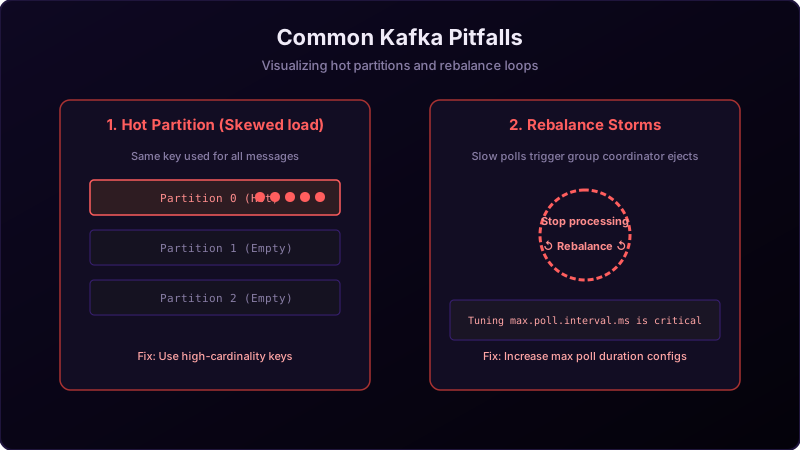
In distributed data stream architectures, maintaining the sequence of business events is often a non-negotiable requirement. For example, in a financial ledger application, processing a bank withdrawal event before the corresponding deposit event can cause false overdraft exceptions. However, a fundamental architectural rule of Apache Kafka is that message order is guaranteed only within a single partition. There is no global, cross-partition ordering mechanism inside a multi-partition Kafka topic. If your application relies on sequential event processing, you must design your producer routing and consumer handling to align with Kafka's partition guarantees. In this guide, we will analyze the key strategies for maintaining message ordering across distributed nodes.

To visualize how partition distribution disrupts order, imagine running a logistics shipping warehouse:
- The Ordered Order: A customer purchases a flat-pack wooden table. The order consists of two sequential packages: Box A (the table legs) and Box B (the table top).
- The Split Delivery (Out-of-Order): If you load Box A onto Delivery Truck 1 (representing Partition 1) and Box B onto Delivery Truck 2 (representing Partition 2), they will take different highway routes. Because of traffic or route layouts, Truck 2 might arrive first. The customer gets the tabletop but cannot construct anything because they lack the legs.
- The Single Carrier (In-Order): To ensure Box A always arrives before Box B, you must load both packages onto the exact same delivery truck (Partition) in the correct sequence. The driver will then deliver them in the exact order they were loaded.
Strategies to Handle Ordering in Kafka
1. Single-Partition Topic (Total Ordering)
The absolute simplest way to enforce global topic-wide ordering is to provision your topic with exactly one partition.
- How it works: All produced records are written to Partition 0. Since a partition is consumed by a single thread within a consumer group, processing is strictly sequential.
- Trade-off: This completely destroys horizontal scalability. Your message throughput is limited to the processing capacity of a single consumer thread, making it suitable only for low-volume settings like configuration properties updates.
2. Key-Based Routing (Per-Entity Ordering)
In almost all enterprise systems, you do not need global, topic-wide ordering. You only need ordering for a specific entity (such as an individual user account, order ID, or IoT device).
- How it works: Assign a logical key (such as
userIdordeviceId) to every message. Kafka's default producer partitioner hashes the key (using the Murmur2 algorithm) and maps it to a specific partition number. All events matching that key are guaranteed to land in the same partition, preserving sequence. - Benefit: Events for different users run concurrently in parallel across all partitions, maximizing throughput while keeping individual user profiles ordered.
// Producing with a key to guarantee partition routing
String key = "user-id-54321";
String eventPayload = "{\"action\":\"ADD_TO_CART\",\"item\":\"laptop\"}";

// Key-based routing guarantees this goes to the same partition as previous user events
ProducerRecord<String, String> record = new ProducerRecord<>(
    "shopping-events", key, eventPayload
);

producer.send(record);
3. Producer Client Configuration Tuning
Even with key-based routing, network retry loops can scramble messages. If a producer sends Message 1, fails due to a network glitch, sends Message 2 successfully, and then retries Message 1 successfully, the broker will store them as [Message 2, Message 1].
To prevent this retry inversion, always configure your producer client with idempotence enabled and restrict flight requests:
# Prevent retry ordering inversion
enable.idempotence=true
max.in.flight.requests.per.connection=5
4. Application-Level Resequencing
If you must process events from multiple partitions but reconstruct their timeline, embed a global sequence number or nanosecond timestamp in the message payload. The consumer can accumulate incoming records inside an in-memory priority queue or sliding time window (using Kafka Streams or custom buffers) and sort them before committing mutations to your database.
Summary & Design Recommendations
For high-throughput systems, the gold standard is Key-Based Routing combined with an Idempotent Producer. This configuration balances massive horizontal scalability with strict sequence guarantees, ensuring that downstream consumers process related business events in the exact order they were generated.